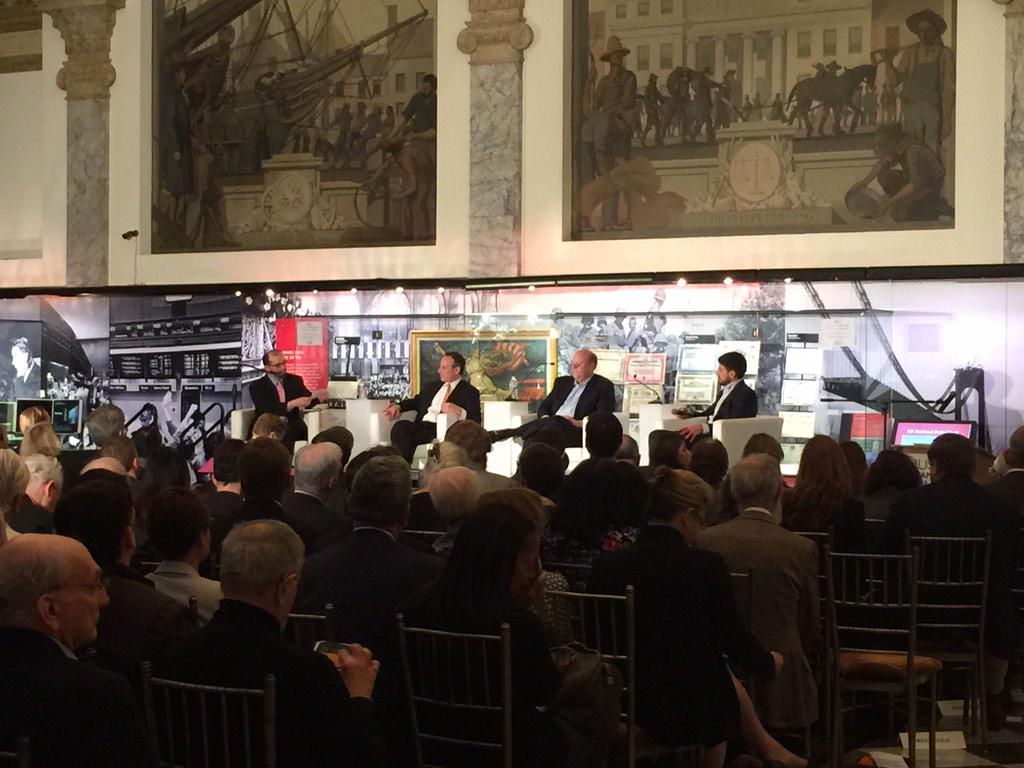
On Wednesday night, Feb. 11, we were part of a special night at the Museum of American Finance on Wall Street, a discussion on digital currency and the future of finance featuring former Treasury Secretary Lawrence Summers that took a look at the ways in which bitcoin and cryptocurrencies are going to effect, and be absorbed and adapted by, the financial system.
Nearly 300 people (the event sold out very quickly) filled the museum’s main exhibition hall to hear Summers, us, and a panel of experts talk about the future of finance, and digital currency’s place in that future.
The museum occupies the old Bank of New York headquarters, a grand old Greek revival building on the corner of Wall and Williams street, a block away from Federal Hall and the New York Stock Exchange. That location and history made for a dramatic backdrop to what was decidedly a 21st century night of questions and discussions.
The media coverage ranged from the mainstream New York Times, which took a very straightforward angle with this write-up of Summers’ comments, to this decidedly cynical take from Animal New York. “On Wednesday night, the Establishment wasn’t afraid,” Peter Yeh wrote. “It was excited. Its members swarmed the CEOs after the panel ended to exchange business cards. Nothing is more traditional finance than that.”
There was something to that take. This was one of the first times, if not the first, that the upstart cryptocurrency world met the staid traditional finance world on its own turf, and engaged it on its own terms. The night was less about disruption and more about evolution, and it seemed to us at least that at some point soon, there’s going to be something in the museum to represent bitcoin, something that extends the line of history just one step further.
It started off with Mike and Summers talking about digital currencies, their significance and where they are headed. “We have seen so little innovation cumulatively directed at taking the frictional costs out of the system,” Summers said. “The notion that there’s going to be a lot of innovation and experimentation around how those frictional costs can be taken out feels like a very important kind of idea.”
Paul then moderated a panel discussion that focused on how digital currencies may end up melding with the modern finance system. The panelists were Lawrence Goodman, president of the Center for Financial Stability, Jeremy Allaire, founder and CEO of Circle Internet Financial, and Chad Cascarella, founder and CEO of itBit.
After that there was a cocktail reception, and we signed copies of the book. It was frankly a dizzying night for us, between the setting and the guests, the crowd and the media.
Here are a few of the tweets that were going out during the night:
@itBit @chadcascarilla: The Internet was to information distribution as Bitcoin is to information authentication #bitcoinpanel
— grace (@grace_chang) February 11, 2015
#Bitcoin in 5,10,20 yrs: “New stores of value and systems for processing payments will come about quickly” -Lawrence Goodman #bitcoinpanel
— Jinyoung Lee Englund (@jinyoungenglund) February 11, 2015
“The payment system has been built on an antiquated infrastructure & Feds and institutions realize this.” -Lawrence Goodman #bitcoinpanel — Jinyoung Lee Englund (@jinyoungenglund) February 11, 2015
25 yrs ago you’d use a landline if you could, car phones were terrible. BTC is clunky today but will be better @chadcascarilla #bitcoinpanel — Dorothy Jean Chang (@dj) February 11, 2015
New York, still center of the world #bitcoinpanel — Peter Yeh (@VerdaFolio) February 11, 2015
Here are some photos from the event (all photos were shot by Paul except were otherwise noted):

Lawrence Summers and Michael Casey

The lobby and main exhibition floor of the museum.

Mike and Paul before the panel (photo by April Rudin).

Mike before his interview (photo by April Rudin).
Here’s some that Paul took of some of the artifacts on exhibit at the museum.
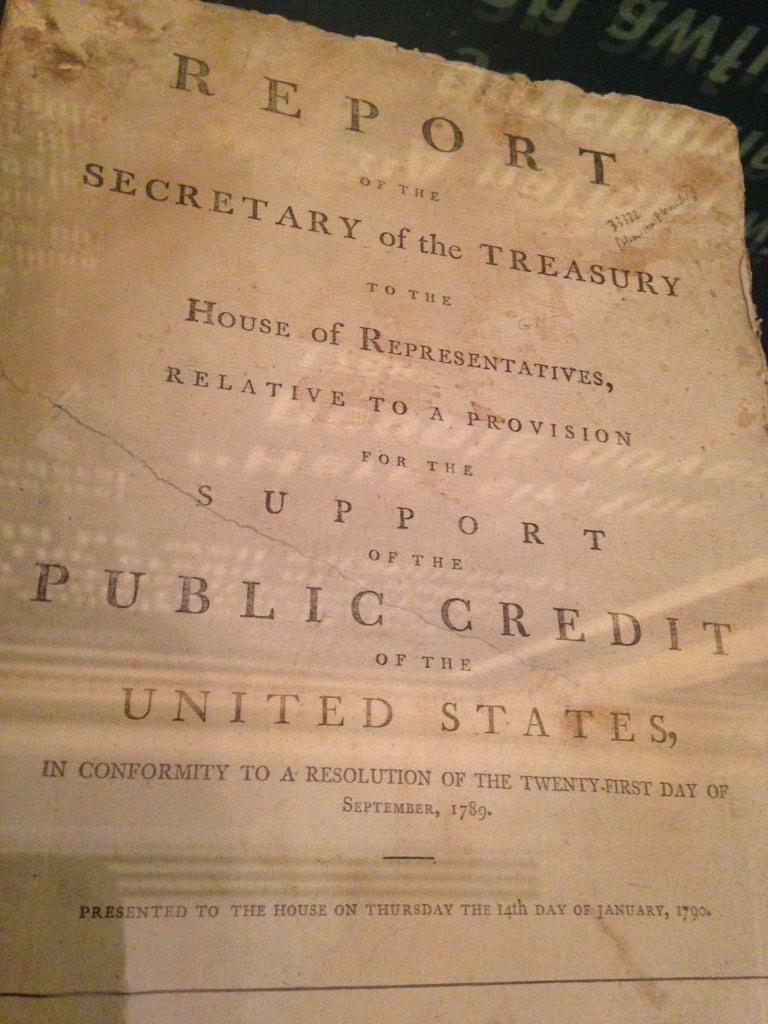
Alexander Hamilton’s report to Congress arguing for issuing, and honoring, federal debt, from 1790.

The New York Post from October 1987.

The first issue of The Wall Street Journal, from 1889.
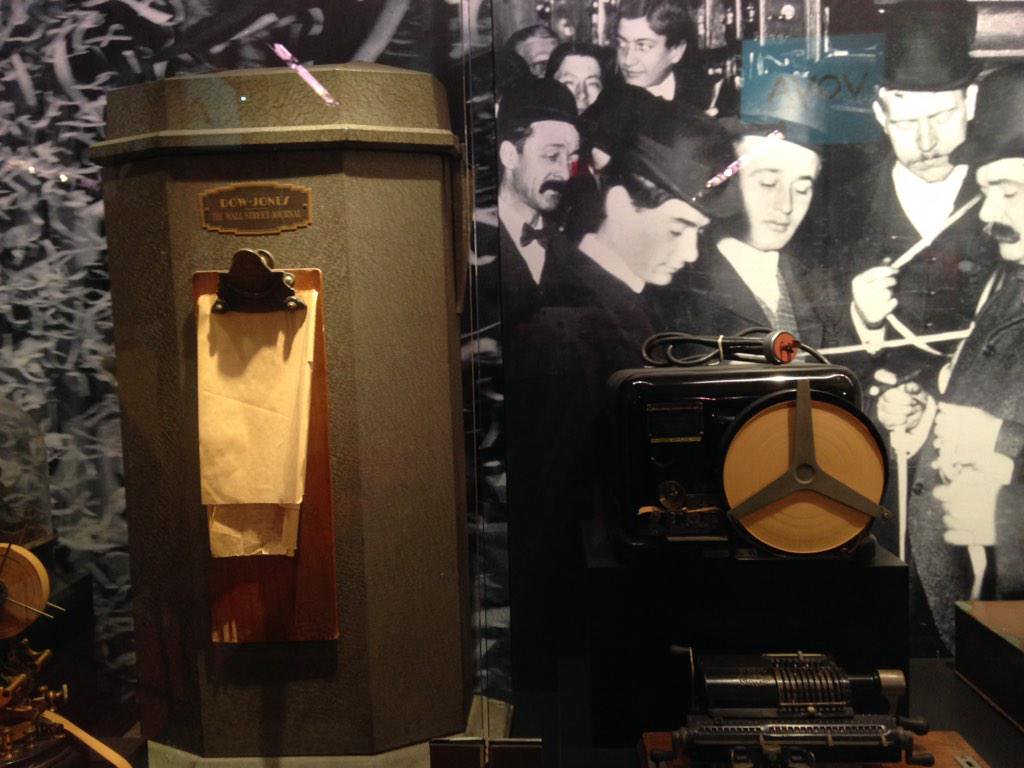
Old ticker tape machines; the one on the left is a Dow Jones model that was used into the early 1990s.

Money bags, literally, from the Federal Reserve.

A gold and jewel encrusted Monopoly board.
